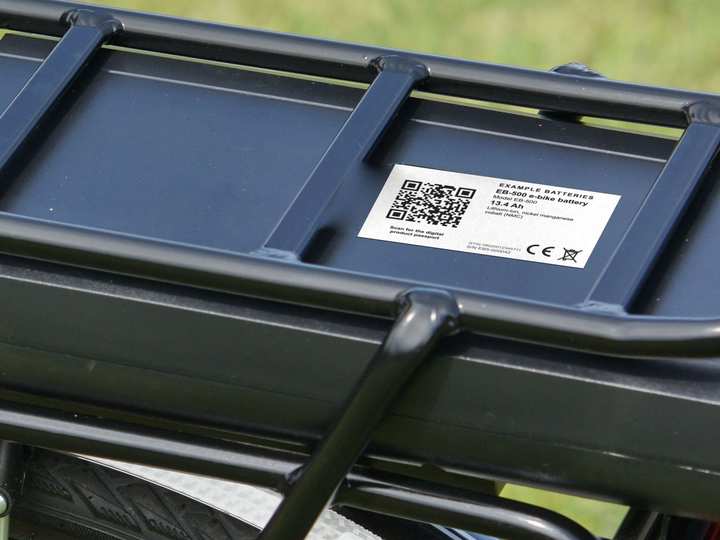
Battery passports are mandatory from 18 February 2027.
Question 1 of 4
What does your company do with batteries?
Choose the option that fits best.
What do you supply?
What type of battery is it?
If you are unsure between two, choose the heavier battery.
What is the battery's capacity?
The capacity is usually stated on the battery or in the data sheet, for example 5 kWh or 5,000 Wh.
When are the batteries placed on the EU market?
That is, when they are first made available in the EU.
The check runs in your browser and needs JavaScript. The rules it is based on are on the EU rules page. All battery rules
Stay up to date on new rules
Why
Stock photo. Brand, product and data are examples.
Your answers
Battery passport required
QR code required
No obligation
Check further
You do not need battery passports, but you do need QR codes
From 18 February 2027, all batteries must carry a QR code. Your batteries are not covered by the battery passport requirement, but they are covered by the QR code requirement.
Industrial batteries only need a battery passport when their capacity is above 2 kWh. But from 18 February 2027, all batteries must carry a QR code, including yours.
Possibly. It depends on the type of battery
The battery passport applies to three types of battery only. Find the battery's type, weight and capacity in the data sheet and take the check again.
Possibly. It depends on whether the units form one battery
If the units share a battery management system or other common components, they count as one battery and the combined capacity is what matters.
Possibly. It depends on the capacity
Industrial batteries above 2 kWh need a battery passport. Find the capacity in the data sheet and take the check again.
Yes, you need to create a new battery passport
A remanufactured or repurposed battery must have its own battery passport, and the new passport must be linked to the original one.
Usually not. The obligation lies with whoever assembles the battery
Separate cells and modules that are assembled into a finished battery in the EU are not normally treated as batteries in their own right. The exception is DIY kits that the end user assembles with commonly available tools.
No, not for those batteries
Batteries placed on the market before 18 February 2027 do not need a battery passport. Every unit placed on the market from that date does.
Probably not your obligation, but check two things
The obligation lies with whoever first places the battery on the EU market. Ask your supplier whether the battery passport is in place.
The obligation lies with your EU buyer, but you can do the work
The battery passport must be registered by whoever places the battery on the EU market. With a written authorisation, you may create and update the passport on behalf of your buyer.
Yes, you are required to create battery passports
Every battery you place on the market from 18 February 2027 must have a battery passport with a QR code, and the passport must be registered in the EU registry.
This applies to all LMT batteries (light means of transport) that you place on the market from 18 February 2027.
This applies to all electric vehicle batteries that you place on the market from 18 February 2027.
This applies to all industrial batteries that you place on the market from 18 February 2027.
Every single battery needs its own battery passport
One passport per model is not enough. Each battery must have:
its own unique identifier, assigned by you
its own QR code on the battery, linking to the passport
information on both the model and the individual battery, updated whenever the battery's status changes
Each battery must be marked with a QR code that links to a page containing the following. If the battery is too small, the QR code goes on the packaging and in the accompanying documents.
the information from the battery's label, for example manufacturer, chemistry, weight, capacity and the separate collection symbol
the EU declaration of conformity
guidance for users on making the battery last longer and on disposing of it correctly once it is used up
From 18 August 2027, where the battery contains cobalt, natural graphite, lithium or nickel, the page must also give access to the battery due diligence report of the company that places it on the market. A company with a net turnover below EUR 40 million, its group included, is exempt.
The QR code must give access to the labelling information, the EU declaration of conformity and information on waste batteries. The information must be complete and up to date. Nothing needs to be registered in the EU registry. Battery Regulation, Article 13(6)
The QR code must give access to the labelling information, the EU declaration of conformity and information on waste batteries. Nothing needs to be registered in the EU registry. Battery Regulation, Article 13(6)
The requirement covers batteries for light means of transport (25 kg or less), batteries that power electric vehicles, and industrial batteries above 2 kWh. Battery Regulation, Article 77(1)
A battery weighing more than 5 kg that is not an electric vehicle, LMT or starter battery counts as an industrial battery. Battery Regulation, Article 3, point 13
If each unit is a complete, independently working battery below 2 kWh, each is assessed separately. If they form one system with common components, the whole system is the battery. Commission FAQ, question 3.3
Industrial batteries above 2 kWh need a battery passport. This includes home batteries and energy storage. Battery Regulation, Article 77(1)
This also applies to batteries first placed on the market before 18 February 2027. A simple repair does not require a new passport. Commission FAQ, questions 9.1, 9.4 and 9.5
The company in the EU that completes the battery becomes the manufacturer and holds the obligation. Commission FAQ, question 3.4
The requirement applies to batteries placed on the market or put into service from 18 February 2027. Battery Regulation, Article 77(1)
If you sell the battery under your own name or trademark, you count as the manufacturer, and the obligation is yours. Battery Regulation, Article 3, point 33
Registration must be done by the economic operator placing the battery on the EU market. An authorisation does not make you an EU manufacturer or importer. Commission FAQ, questions 2.2 and 2.4
Another company, such as a third party or a manufacturer outside the EU, may create and update the passport with a written authorisation. Responsibility stays with whoever places the battery on the market. Commission FAQ, question 2.1
If you import a product with a finished battery built in, the battery is placed on the market when the product is imported, and you are responsible as the importer. Commission FAQ, question 3.5
If you assemble imported packs and a battery management system into a finished battery in the EU, you are responsible. Commission FAQ, question 2.5
On 18 February 2027, the passport does not yet have to include carbon footprint, recycled content or due diligence information. Those requirements have their own dates. Commission FAQ, question 7.2
You may authorise another company in writing to create and update the passport for you. Responsibility remains yours. Commission FAQ, question 2.1